But Do Microtrends Show a Market Change Around the Corner?
Every news story you hear about the local real estate market says the same thing: The Market Is Hot! Prices Are Rising! Homes Are Selling At Record Rates!
Although these assertions are true and supported by local statistics, there is another side to the same story that isn’t getting reported as widely. Trends that might not seem as favorable or have the same flashy headlines to go alongside them start to appear if you dive deeper into the numbers. When you look closer, there is a different story that the real estate industry at large hasn’t yet realized or verbalized, especially in the suburbs.
It is a hot seller’s market without question, but could we be in the midst of a slight shift? There are relatively the same number of homes on the market right now as this time last year. Last year most homes priced at $200,000 or below were getting 7 to 15+ offers. Today the same house still sell quickly, but with generally just one to three offers on it despite there being about the same amount of inventory on the market.
Higher end homes were selling quickly as well last year, some with multiple offers and some just as fast and for premium list prices. This year these same types of homes are still selling, but some listings sit on the market a bit longer before going under contract. So why is no one questioning the slowdown in quantity of offers and the increase in days on market for certain segments of the market?
Again our market is still very hot without question. We just love to watch the micro trends as well since we were one of the only ones pushing prices up when the market was down or flat. Paying attention to changes in the micro trends in ways others didn’t allowed us to push the prices higher during slower times for certain products.
We are now at the tail end of a seven-year climb in prices with low inventory and a general decrease in the number of offers on a home. New home builders are finally catching up to demand, and sometimes when they do, overbuilding can take place especially if the market shifts quickly. We are not there yet, but we always watch for this.
I’m an optimist by nature and love to see our local real estate market doing so well, which it is! I also make sure I’m watching all the data instead of just paying attention to the numbers that tell the happiest story. It also helps to know how trends in the market place generally work and what one should be watching. In a big city like Austin, know that generally the outlying areas will start to feel the change or shift first before the major city will. The farther out you go from Austin, the more you could start to feel changes first. If home sales start slowing, they’ll slow first in the outlier areas and market data looking at the general Austin area might not allow these changes to be easily seen until things get worse for the bigger suburbs and the major hub city as well.
The higher priced homes in the outer suburbs will also feel the shift first, which is one of the micro data points we like to watch. There have been more higher priced buyers in the Round Rock area than we have seen in a long time, which is great, but more high-end inventory has entered the market all at the same time. This is causing more expensive homes to generally sit on the market longer, though homes priced to match their upgrades are still selling quickly and often getting multiple offers. Any significant change in the total volume and days on market of the available suburban homes in the higher price range can be a significant sign of a market shift.
It is still an amazing time to buy a home even at today’s prices because of current low interest rates and mere popularity of the area. The suburbs will see the first signs of a market change, and that is where it is wise to watch. Do I think there is going to be a major drop soon? I do not think so, especially not before a presidential election. However, I do watch the micro data when a correction might be coming, and a correction always has to come at some point. The question is when will we see it in the Austin market?
There have been several business people predicting the same thing nationwide. What does that mean for our local Austin/Round Rock areas? Last time there was a down turn, our area took a hit, but nowhere near the hit the rest of the nation saw. I think we are blessed to be in such a great location, which should help keep us stronger than most areas around the nation, even in a downturn. So even if there is a correction (depending on why it occurs and what else is going on economically), it probably will not be as drastic as most places in the country.
Just looking at this from a real estate financial advisor side: I like people to know, think, and plan ahead for their family. I still believe it is a great time to buy and sell at all price ranges when taking into consideration where prices are, interest rates, etc. The higher the price of the home, the more you might need to consider what your short and long term plan is as higher priced homes will get hit first whenever a market shift takes place, especially in the suburbs. I still know our local market is great and we are pushing prices where we know we can and we absolutely love doing that. Just look at the big picture, the micro data, and plan for the future for what best fits your situation.
And here is the data most everyone is reading about, though specifically targeted to trends in Round Rock. These are the “marketing” numbers the media puts out, which are accurate numbers straight from the Austin Board of REALTORS®. The micro data is harder to quantify and advertise because it requires more digging, includes anecdotal information and involves data points that aren’t as easily tracked.
Home sales in the general Austin area have hit historic highs each month in 2015 with the median home price hitting an all-time high in March 2015. With more people moving to the Austin area each day, it’s no surprise that homes are selling faster and more competition for fewer homes is causing prices to rise. We looked at all the homes sold in 2015 through May 1 and compared it to the same time period in 2014 to find that Round Rock homes are seeing similar increases in number of sales as well as home prices in 2015.
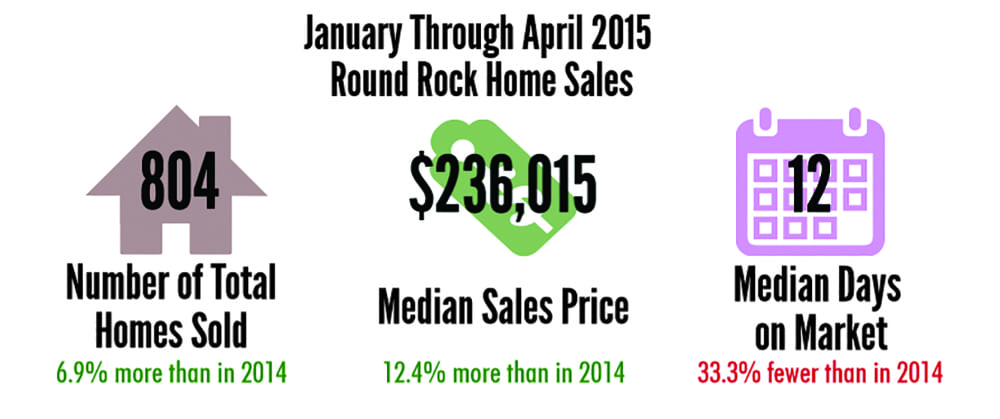
In the first four months of the year, 804 homes sold in the city of Round Rock, an increase of 6.9 percent compared to the 752 homes sold during the same time period in 2014. This increase in sales might seem surprising considering the lack of inventory seen on the market at any one time in 2015, but that’s because homes are selling much quicker. The number of homes that have been listed as active on the market has increased 3.6 percent in 2015, but with median days on market at just 12 days, these houses aren’t staying around long enough to maintain inventory.
Increases in home prices match closely to what is being seen in the Austin area overall. So far in 2015, the median home price in Round Rock has hit $236,015, which is 12.4 percent more than in 2014. While this is lower than Austin-area prices, it does show that homes continue to get more expensive in Austin’s most popular suburb. This could contribute to the growing problem of affordability in housing that has become an issue in the greater Austin area in recent years. It also means property taxes will continue to increase for the foreseeable future even if local and county tax rates remain the same.
So what do these numbers mean to those in the market to buy or sell in the Round Rock area in the near future if we were to ignore the micro data? Prices will most likely continue a steady increase though probably at a slower pace throughout the summer, especially now that more people are placing their homes for sale and buyers have more options. The Round Rock housing market will continue to be a strong sellers’ market, though certain areas of town will be stronger than others. Overall our city’s economic health and amazing reputation will continue to make it an appealing place for families to move, which should keep our housing market going strong.
