By: HomeTeam Inspection Service of Austin

Today’s Stucco
As a home inspector, this is one of the most common questions we receive. “What type of Stucco is this?” and “What is this EIFS stuff all about?”
Well, to begin with…
Fortunately, exterior wall treatments that we commonly find in Central Texas and elsewhere throughout the US, is not actually stucco, but rather Exterior Insulation Finish System or EIFS. “Stucco” wall systems that are composed of foam, resins, and fiberglass (like EIFS) are actually not stucco. Traditional stucco walls consist of several cement-based layers – typically over concrete or concrete block walls.
Historically, traditional stucco has been plagued by varying issues – generally incurred by moisture intrusion. While there are two types of EIFS, Polymer-based (PB) and Polymer-modified (PM) – one is not likely to encounter PM EIFS as PB EIFS accounts for over 99% of all EIFS clad homes built in the last 10-15 years (per the EIFS Industry Manufacturer’s Association).
EIFS is an acrylic based system applied over an insulation panel, giving an “R” value to the wall; while stucco is a cementitious based system that does not give an “R” value to the wall, since it lacks insulation. Therefore, EIFS provides the benefit of insulation and efficiency that traditional stucco walls do not.
Stucco or EIFS?
“Tap” Test: Tap your fingertips on the façade. If they produce a hollow sound – then it is likely EIFS.
“Push” Test: Press your thumb against the façade. If there is any deflection or you can feel the wall “give” a little, then the wall is likely constructed of EIFS.
Properly installed PB EIFS does not typically produce cracks in the field of the wall because of the reinforcing mesh embedded in the thin base coat and the properties of the baser and finish coats. If EIFS does crack, the cracks will be smaller and typically around wall penetrations, such as above or below window or doors where proper joint provisions were not provided. Stucco, on the other hand, can crack in the field of the wall in addition to at the corners of windows.
PB EIFS Construction
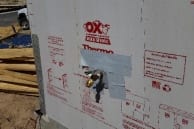
- First, a base layer of expanded polystyrene (EPS) insulation panels and wire are placed over the wall sheathing.
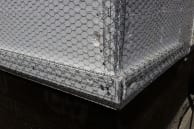
- Next, a thin base coat (typically about 1/16-in) is applied over the EPS panels, with a fiberglass mesh or fiberglass fibers mixed into the base coat.
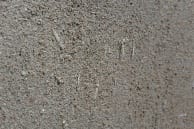
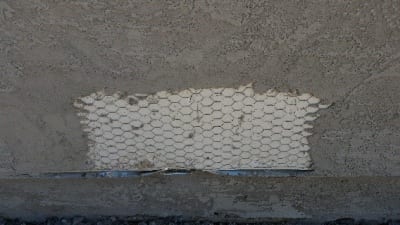
- Finally, the finish coat is applied over the base coat, which can be painted or colored by pigmented finish coat.
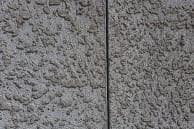
EFIS provides many advantages that other exterior finishes and sidings do not. Chief among these are superior energy efficiency and great design flexibility. Studies indicate that EIFS can reduce the air infiltration in a wall by as much as 55%, when compared to standard brick or wood construction. One should bear in mind that an EIFS system is a non-structural component of the wall. In other words, it is not designed to be weight bearing.
Maintaining Your EIFS
The architectural designs made possible by EIFS construction can achieve desirable and marketable features. It is critical, however, to carefully maintain EIFS to prevent water intrusion and deterioration. These guidelines should be followed to protect your investment:
- Annually, Inspect all sealant - around windows, doors, penetrations through the EIFS, EIFS transitions (such as EIFS to brick, EIFS to stone), and stucco terminations (at roof, at grade, at patios or walkways). Arrange for prompt repair of any areas of caulk that is split, cracking, crazing or is losing adhesion. Also, promptly repair any cracks in the EIFS.
- Any damaged areas, cracks, areas of discoloration, mold or mildew - should receive prompt attention and receive repairs as necessary.
- Anytime you make a penetration through the EIFSsuch as for an ornamental wall item, to mount a satellite dish, add shutters, new wiring, cables, security systems, etc., the perimeters must be sealed with a quality sealant approved for EIFS.
- Periodic cleaningof the surface is necessary to maintain its appearance and prevent permanent staining. Pressure cleaning equipment must be calibrated to the EIFS manufacturer’s recommended pressure level (low) to prevent damage. Select a firm with experience in cleaning these EIFS systems. There are no products that are totally maintenance free, and EIFS is no different.
If you have questions about stucco or Exterior Insulation Finish System, call the HomeTeam Inspection Service of Austin at 512.365.8311 or visit their website at www.hometeam.com/northaustin
